Episodes and robo
One trial runs one episode. robouse run starts an episode server for the task, gives the agent a fresh workspace and waits for the agent to finish.
The agent gets a temporary workspace with instruction.md and an observations/ folder for camera images, robo first on its PATH, and ROBOUSE_SOCKET pointing at the episode. There is no reset, teleport or state-setting request: the only way to change the scene is to move the robot.
robo info and robo observe cost nothing; every simulated step of act, move-to and grip counts against the task's max_steps. The ending, recorded as outcome in episode/result.json, decides the reward. Not shown: the wall-clock limit (wall_time_exhausted, 0) and a harness that exits without robo done (gave_up, 0).On vision tasks, robo observe also saves camera images into the workspace, and the agent opens them like any other file. This is the first image from arc-gravity-vision:
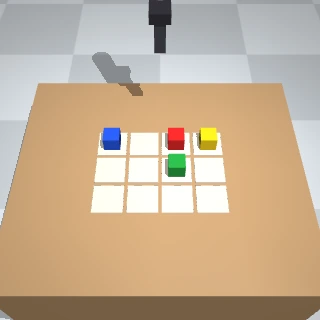
observations/obs_001_front.png, the 320×320 front camera image the agent gets from robo observe on arc-gravity-vision. The agent must infer the rule from example grids and move the blocks it sees.A session#
This is a real session on metaworld-reach, whose success mode is first:
$ robo info
task: metaworld-reach
backend: metaworld
action: ['dx', 'dy', 'dz', 'grip'] low=[-1, -1, -1, -1] high=[1, 1, 1, 1]
  dx/dy/dz: end-effector velocity, about 1 cm per unit per step; grip: +1 close, -1 open
skills: ['move_to', 'grip']
steps_used: 0
max_steps: 500
observation_mode: state
$ robo observe
state:
  hand_pos: [0.0042, 0.6005, 0.1946]
  gripper_open: 1.0
  obj1_pos: [-0.0125, 0.6892, 0.0196]
  obj1_quat: [0.0003, -0.0003, 0.0, 1.0]
  obj2_pos: [0.0, 0.0, 0.0]
  goal_pos: [-0.0233, 0.8792, 0.1822]
steps_used: 0
max_steps: 500
$ robo act 0 1 0 -1 --repeat 5
executed_steps: 5
state:
  hand_pos: [0.0004, 0.6205, 0.1949]
  ...
steps_used: 5
$ robo move-to -0.0233 0.8792 0.1822
reached: False
distance: 0.0336
executed_steps: 31
state:
  hand_pos: [-0.0208, 0.8459, 0.1852]
  ...
steps_used: 36
episode: finished: goal reached, episode scored as solved
Every simulated step counts against max_steps, including the steps a skill such as move-to takes. All commands: robo reference.
The trial folder#
robouse run --out runs/try writes one folder per trial, runs/try/<task>__<harness>__<id>/:
| Path | Contents |
|---|---|
config.json | task, harness, --model and --seed as given, timeout, whether the sandbox was on |
result.json | reward, episode outcome, model, timing, any runner exception |
agent/stdout.jsonl, agent/stderr.txt | the harness's raw output |
agent/trajectory.json | the agent's steps in ATIF v1.7, the trajectory format BenchFlow reads |
episode/result.json | the episode server's verdict: success, outcome, steps_used, the seed used |
episode/trace.jsonl | every robo request and response, with times |
verifier/reward.txt | 1 or 0 |
artifacts/recording.mp4 | the episode video |
artifacts/observations/ | camera images from the episode's workspace |
Outcomes: done (the agent called robo done), success_reached (success mode first), gave_up (robo give-up, or the harness exited without robo done), budget_exhausted, wall_time_exhausted, agent_timeout (the harness hit its time limit) and agent_exited (the server was shut down mid-episode; the BenchFlow verifier does this).